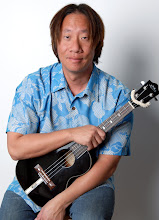
Summer is definitely getting into high gear - I can tell from all the fun party and wedding events I've been playing for! This past weekend I was hired for another summer wedding event - this time, ukulele-only music was requested for the ceremony. The bride was actually someone I met through the new ukulele class I started on Mondays at the South Bay Adult School and she had some special requests like my What A Wonderful World for the bridesmaids, Pua Lililehua for the Processional, and since the groom's parents are from England, my arrangement of Here Comes The Sun for the Recessional. You know, given his love for the instrument, I wouldn't be surprised to learn that George Harrison wrote the song on an ukulele. Here's a fun video of George with his uke, hanging with Ringo and Sir Paul.
Got a few more ukulele weddings happening this summer so I'll have a chance to whip out some new arrangements of I'm Yours, Summertime, Sway, Top Of The World and some other fun stuff I've been working on.
Showing posts with label ukulele. Show all posts
Showing posts with label ukulele. Show all posts
Tuesday, August 24, 2010

Thursday, August 19, 2010
Intro To Playing Ukulele Scales
 You don't want to always be only strumming chords do you? It's fun playing the melody to your favorite songs and here's an easy way to get started.
Up/Down
Lots of people who've been playing 10+ years still don't know the proper "up" and "down" so we need to clarify this right now:
Put your finger on the fifth fret of any string. There should be a fret marker dot there. Now move that finger to the sixth fret of the same string. The sound went "up" therefore this is what we call "up". Always think of the sound, not which way your fingers/ hands are physically moving. Moving from fret to fret is also known as a half step. From the fifth fret to the tenth, your finger
moved UP five frets/half steps or two whole steps and one half step. Simple enough, no?
The Major Scale
I assume you're already familiar with this: Do Re Mi Fa So La Ti Do. Eight notes and a song/sound we are all very familiar with. This is the sound of a major scale and there is a formula behind the series of notes that gives it its familiar sound.
Basically, any scale is simply a given series of whole step and half step movements (whole = 2 frets, half = 1 fret). For a major scale it is: Root - W - W - H - W - W - W - H.
Here's how it works: Choose the 3rd string open as a starting point. This is the C string therefore our first note is C, otherwise known as the "root".
From this open string, play the note on the 2nd fret which is a whole step (2 frets) UP.
Then move up another whole step (2 frets), then a HALF step (1 fret), a whole step (2 frets), a whole step (2 frets), a whole step (2 frets), then finally a half step (1 fret) for a total of eight notes.
You just played the C major scale!
Frets played = 0, 2, 4, 5, 7, 9, 11, 12.
Notes played = C, D, E, F, G, A, B, C
It doesn't matter what your starting point is. As long as you apply the same formula and there are enough frets on your uke to play all eight notes, you can play any scale (any key) you want.
Is it a little cumbersome to try to play a whole scale on one string? Yes. That's why there's more than just one string on the ukulele. Watch this video to learn how to play the C scale across three strings instead of just one.
It's a damn good lesson! I also talk about articulation and how to figure out melodies so check it out!
Wednesday, July 28, 2010
Mighty Uke Movie: Hollywood Premiere and Radio Interview
 You've probably been hearing a lot of buzz about this movie about "The amazing comeback of a musical underdog".
 "A must-see...it will leave you with a burning desire to get your own ukulele." - PDX Pipeline, Portland
"Offers key musical discoveries every 3 minutes." - Chronogram .com
"The Way a documentary should be put together."
- Westender Magazine
And if you don't believe these reviews, at least you can trust my mom who called me from Hawaii to tell me how much she enjoyed it. Be sure to catch a special interview with the movie's Producer and the Hollywood premiere:
Thursday July 29th 11:15 am (PST)
Tune in to "The Global Village" on KPFK 90.7 FM (98.7 FM Santa Barbara) and online at http://www.kpfk.org
Tony Coleman, producer of the new motion picture "Mighty Uke" stops by to talk about the experience of making this wonderful documentary about the Ukulele, its newfound popularity, and the Hollywood Premiere of the film (see below).
Saturday, August 7
Event begins at 5pm, film starts around 7:30pm
"MIGHTY UKE" screens at Grauman's Egyptian Theater, 6712 Hollywood Blvd in Hollywood, CA.
There will be Tiki vendors and booths in the Egyptian courtyard and at 5pm a Hawaiian Luau, a performance by King Kukulele, the Polynesian Paradise Dancers, a special Tiki slide show by King Kukulele - all followed by the film "MIGHTY UKE". Film maker Tony Coleman will also be there for a Q & A after the film! Don't forget to bring your uke for a strum-along after the movie! There will also be a raffle for a Kala ukulele from the film sponsors Kala Brand Music. Get your tickets here
Tuesday, April 21, 2009
Beginning Ukulele Players
So last week Wednesday was the first day of a new class I'm teaching at the Torrance Adult School. Everyone seemed to really enjoy it and seeing how they learned so much on just the first day, they said they were really looking forward to the next week's class (tomorrow).
First thing I wanted to show them was how easy it was to get started so I showed them the one-finger C chord followed by the one-finger C7 chord then F then back to C again. Everyone seemed to already be familiar with basic strumming but as expected, mostly with that typical "swing" feel. So I showed them how to count out beats while strumming and when to expect typical chord changes. Eventually I will show them the strumming pattern made popular by Bruddah Iz with his version of "Somewhere Over The Rainbow" which, if you haven't heard by now, must mean you've been living in a cave.
Check out this video for an explanation on how to emulate that strum and be able to figure out others as well. Let me know what you think!
First thing I wanted to show them was how easy it was to get started so I showed them the one-finger C chord followed by the one-finger C7 chord then F then back to C again. Everyone seemed to already be familiar with basic strumming but as expected, mostly with that typical "swing" feel. So I showed them how to count out beats while strumming and when to expect typical chord changes. Eventually I will show them the strumming pattern made popular by Bruddah Iz with his version of "Somewhere Over The Rainbow" which, if you haven't heard by now, must mean you've been living in a cave.
Check out this video for an explanation on how to emulate that strum and be able to figure out others as well. Let me know what you think!
Friday, March 20, 2009
New Class for Beginner Ukulele Players
Always wanted to learn to play 'ukulele but didn't know how to start? Frustrated with confusing books and instructional methods? Want to learn how to figure out songs and strums by ear in seconds, hours/days/years? Then this class is for YOU!
This is a new 8-week course being offered at the El Camino College Community Education series in Torrance, CA starting June 16th through August 4th. Class size is limited so please register here to reserve your space.
Check out some of my ukulele tutorial videos to get an idea of what we'll be covering. The ukulele is a fun instrument, totally portable and very underrated in its versatility!
See you there!
This is a new 8-week course being offered at the El Camino College Community Education series in Torrance, CA starting June 16th through August 4th. Class size is limited so please register here to reserve your space.
Check out some of my ukulele tutorial videos to get an idea of what we'll be covering. The ukulele is a fun instrument, totally portable and very underrated in its versatility!
See you there!
Saturday, March 14, 2009
Ukulele Virtuoso Abe Lagrimas
I just got back home from watching a(n) ukulele performance by Abe Lagrimas in the Island Bazaar shop in Huntington Beach. This guy is amazing for not even being a full-on dedicated ukulele player. Abe's main instrument is the drums and vibes and he is a graduate of the Berklee School of Music if that tells you anything about his musical abilities. Interesting thing about him is that he actually prefers the high G string on the uke as opposed to a G tuned lower like most people who solo like to use. He actually incorporates that high G into his runs which is way more thinking than I want to do!
I first met him back in 2006 when I decided to get back into organizing concerts. This one featured Jeff Peterson, Dana Hanchard who is an incredible singer, Abe on drums (and some ukulele) and Ernie Provencher on bass. Abe has since moved to Los Angeles and is making the rounds on the jazz scene here. I was able to recruit him to play a little in my 1st Southern California Slack Key Festival and also my first Aloha Falsetto Festival, both in Redondo Beach. In the slack key show, he played with Jeff Peterson on guitar and Kristin Korb on upright bass, as part of a backup band behind Owana Salazar. And in the falsetto show, he played with Jeff Peterson again and Taumata Grey on bass as the "House Band" that backed up Steven Espaniola, Gary Haleamau and Raiatea Helm.
You must check out his CD - way more sophisticated than any other ukulele CD out there, TRUST ME. Plus he is the one, of course, playing the percussion on there. He's only like, 26 but you will be very impressed!
I first met him back in 2006 when I decided to get back into organizing concerts. This one featured Jeff Peterson, Dana Hanchard who is an incredible singer, Abe on drums (and some ukulele) and Ernie Provencher on bass. Abe has since moved to Los Angeles and is making the rounds on the jazz scene here. I was able to recruit him to play a little in my 1st Southern California Slack Key Festival and also my first Aloha Falsetto Festival, both in Redondo Beach. In the slack key show, he played with Jeff Peterson on guitar and Kristin Korb on upright bass, as part of a backup band behind Owana Salazar. And in the falsetto show, he played with Jeff Peterson again and Taumata Grey on bass as the "House Band" that backed up Steven Espaniola, Gary Haleamau and Raiatea Helm.
You must check out his CD - way more sophisticated than any other ukulele CD out there, TRUST ME. Plus he is the one, of course, playing the percussion on there. He's only like, 26 but you will be very impressed!
Friday, March 13, 2009
Top/Bottom, Up/Down?

Before I explain more about the Dominant 7th and other important chords, it's important for everyone to be on the same page and to use the same terminology, especially for those who like to read online without a personal teacher. And even then, some teachers don't know how to explain things well in the first place, they're just "Do what I do" and can't go beyond that.
What follows assumes that you are a right-handed individual.
Look at the ukulele face on, vertically, like in the image above. The notes of the open strings, from left to right, is G, C, E, A. What that means is when you pluck the string all the way on the right, without pressing anything down, the note you hear (when the ukulele is properly tuned) is A. The A string is also known as the "TOP" string and also the "FIRST" string. This messes up a lot of people. The E string is the 2nd string, the C string is the third and the G string (regardless if you have a low or high G string) is the fourth, or BOTTOM string.
Put your left index finger (this is your FIRST finger) on the 1st fret of the first string. Recognize that chord? If you strum all the strings while holding that down it is a C7 chord. Now, move UP 2 frets. Your first finger should now be in the THIRD fret of the same string and you should recognize that as the C major chord when you strum all the strings together.
Notice that the SOUND of the note you played at the third fret is HIGHER than the sound of the note you played at the first fret. That's how you remember that you went UP and not DOWN.
Play a Bb chord. Your first finger is holding down the 1st and 2nd strings, right? Now move UP 2 frets so that the same finger is holding down the same strings but at the third fret. You are now playing a C major chord. You can play this interchangeably with the one-finger version but the main difference is that now you can move this chord shape around to get other chords, more on this later.
Up/down/top/bottom may seem knit-picky but these are VERY important things to know that will help communicating with and learning from others. See my videos for other mini-lessons and let me know what you think or if you have any questions.
Friday, February 27, 2009
Ukulele Theory #1 - the Dominant 7th
Last blog I mentioned that in a particular song there was a "mystery" chord that preceded the Bm chord that drove my friend crazy because he couldn't figure it out. It was the bridge section of the song "Lei Ho'oheno" by Weldon Kekauoha.
Well, when you hear it, there is really only one choice as to what that chord could be. So, to save you a LOT of time, here's how to figure it out: take the letter "B" and count forward in the alphabet four letters. You get "F". So if you were to use the letter "B" as #1 - the starting point - "F" would be #5. 1 = B, 2 = C, 3 = D, 4 = E, 5 = F
Now take that "F" and look up in your ukulele chord book how to play F7 and try that as the chord preceding Bm.
I tricked you - it probably still doesn't sound quite right, eh? Now, here's the next thing you gotta do: add a "#" to that to make it an F#7 chord. Now when you play that chord leading into the Bm, it's a very strong resolution and sounds like surf music or Spanish music. Try it for "Hotel California", too.
This is what's called a Dominant 7th chord - it's always 5 letters away from your destination chord and will always be the strongest, most satisfying kind of resolution. Try just playing those two chords - Bm and F#7 - back and forth....sounds good eh? You can also go between Bm and a regular F# major chord without the 7th but note the difference the F#7 makes. Practice strumming it fast and slow and see the difference there, too.
Now try the Am chord and go through the same process to figure out what the Dominant 7th chord will be. Did you get E#7?
That is.....INCORRECT! Correct answer is E7! Why? See if you can figure it out on your own before the next posting!
If you live anywhere near the Redondo Beach/South Bay area in Los Angeles, please contact me for private or group ukulele lessons!
Well, when you hear it, there is really only one choice as to what that chord could be. So, to save you a LOT of time, here's how to figure it out: take the letter "B" and count forward in the alphabet four letters. You get "F". So if you were to use the letter "B" as #1 - the starting point - "F" would be #5. 1 = B, 2 = C, 3 = D, 4 = E, 5 = F
Now take that "F" and look up in your ukulele chord book how to play F7 and try that as the chord preceding Bm.
I tricked you - it probably still doesn't sound quite right, eh? Now, here's the next thing you gotta do: add a "#" to that to make it an F#7 chord. Now when you play that chord leading into the Bm, it's a very strong resolution and sounds like surf music or Spanish music. Try it for "Hotel California", too.
This is what's called a Dominant 7th chord - it's always 5 letters away from your destination chord and will always be the strongest, most satisfying kind of resolution. Try just playing those two chords - Bm and F#7 - back and forth....sounds good eh? You can also go between Bm and a regular F# major chord without the 7th but note the difference the F#7 makes. Practice strumming it fast and slow and see the difference there, too.
Now try the Am chord and go through the same process to figure out what the Dominant 7th chord will be. Did you get E#7?
That is.....INCORRECT! Correct answer is E7! Why? See if you can figure it out on your own before the next posting!
If you live anywhere near the Redondo Beach/South Bay area in Los Angeles, please contact me for private or group ukulele lessons!
Thursday, February 19, 2009
Music Theory for the 'Ukulele??
Starting a new blog for learning about the ukulele, intending to focus a little more on the playing and musical theory aspect of the instrument. If you have any questions about songs, chords, strums, flats, sharps, etc. please post them! Lots of folks play for years and years without knowing just a few key things that would make life a lot easier when it comes to learning songs and think it's all one big mystery or that it takes too much time to even bother to try to learn - they are robbing themselves of so much fun and pleasure!
For my first case study (lol), last night I was talking with a friend about a song by Weldon Kekauoha called Lei Ho'oheno and he said it'd taken him a long time just noodling around trying to figure out the chords and eventually got pretty much all of them except for ONE chord and it was driving him nuts. He knew that the 2nd chord of the bridge was a Bm chord but for the life of him, couldn't figure out the one that precedes it no matter how many chords he tried to plug in there. Well, I informed him it was an F#7 chord which, if you knew just a little bit of theory, was really the only choice, kind of an instantaneous process of elimination. Think of the time he would have saved!
Want to know how this all works? Stay tuned and subscribed!
For my first case study (lol), last night I was talking with a friend about a song by Weldon Kekauoha called Lei Ho'oheno and he said it'd taken him a long time just noodling around trying to figure out the chords and eventually got pretty much all of them except for ONE chord and it was driving him nuts. He knew that the 2nd chord of the bridge was a Bm chord but for the life of him, couldn't figure out the one that precedes it no matter how many chords he tried to plug in there. Well, I informed him it was an F#7 chord which, if you knew just a little bit of theory, was really the only choice, kind of an instantaneous process of elimination. Think of the time he would have saved!
Want to know how this all works? Stay tuned and subscribed!
Subscribe to:
Posts (Atom)